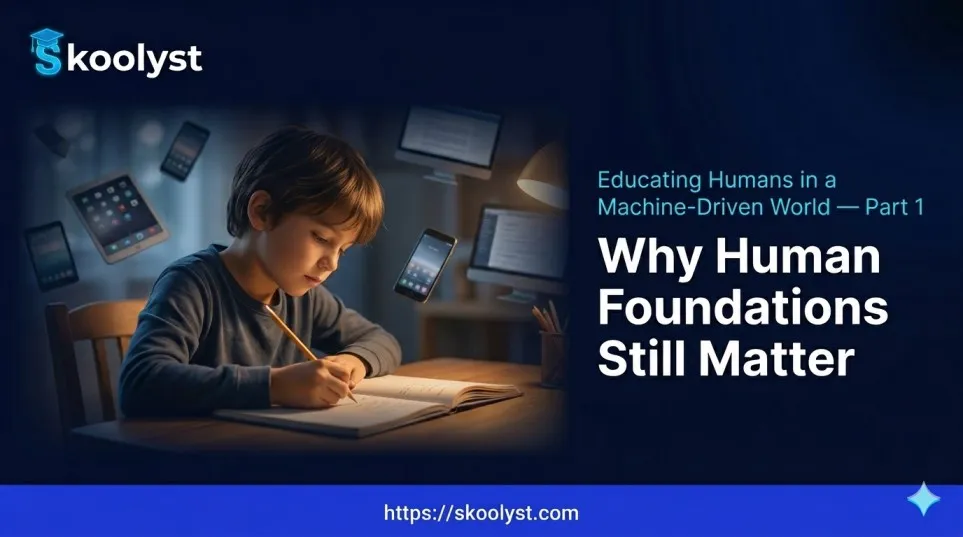
A Classroom Full of Screens
Walk into many classrooms today and you will see screens everywhere. Smart boards have replaced blackboards. Tablets have replaced notebooks. Apps have quietly taken the place of conversations.
It all looks impressive — but a quieter question remains unanswered: Are we educating humans, or training students to depend on machines?
This is where every teacher must pause and reflect.
The Power of Struggle in Learning
Traditional methods — chalk on a blackboard, words written by hand, a problem worked out slowly on paper — often feel slow in a world that rewards speed. Students struggle. They make mistakes. They repeat the same lesson until it finally clicks.
But this struggle is not a weakness. It is the very foundation of strong thinking.
A child who learns to write with their own hand develops patience. A student who solves a problem without rushing to Google builds real confidence. A learner who explains an answer aloud, in their own words, discovers what clarity feels like.
Machines give answers. Teachers build minds.
When Machines Stop, Humans Must Start
Picture an ordinary day that suddenly turns difficult. A water pipe bursts at home. The electricity cuts out in the middle of the night. A family member falls seriously ill.
There is no app that fixes any of this instantly. There is no machine that feels urgency, or carries responsibility. In those moments we need humans — the plumber, the electrician, the doctor, the farmer, the worker who shows up because someone has to.
If machines truly replaced humans, the world would stop functioning by the end of the week. Technology exists to make human life easier, not to remove humans from life itself.
What Students Are Missing Today
Many students today believe the future belongs only to IT and software careers. They are running toward screens without ever pausing to understand the world behind them. They rarely ask who grows the food on their plate, who protects the water in their tap, who maintains the city they live in, or who cares for people when systems break down.
Teachers have a quiet but powerful role here — to reconnect students with the real world. The one that runs on human effort, human emotion, and human responsibility.
Education Is Also About Awareness
To survive and to grow, humans depend on forests and trees, on rivers and oceans, on animals and agriculture, on the land and the climate that holds it all together. Machines do not protect any of this. Machines do not care about life.
Only humans do.
If students are not taught this awareness early, technology will keep growing — but humanity will quietly shrink.
What Parents Truly Look For
Parents do not send their children to school only to learn software. They want their children to grow into responsible adults, confident decision-makers, caring humans, and skilled problem-solvers.
Schools that focus on human development first earn something money cannot buy — trust. Trust builds reputation. Reputation, in time, builds the kind of school families talk about for years.
A Question Worth Asking
Technology is powerful. But power without direction is dangerous. If we teach students how to use machines but forget to teach them why, when, and for whom — we fail our deepest responsibility as educators.
The real question is not, "Should schools use technology?"
The real question is, "How can teachers use technology without losing humanity?"
In Part 2, we will explore how technology should be treated not as a job replacement, but as an opportunity — a tool teachers can use to enhance learning, expand thinking, and prepare students for a balanced future. Because the future does not need more machines. It needs better humans who know how to use them.


Comments (0)
Join the Conversation
Please log in to leave a comment and share your thoughts.
No comments yet
Be the first to share your thoughts!