A Quiet Worry in Every Staff Room
Many teachers carry a quiet worry these days. They hear the same statements repeated everywhere: "AI will replace jobs." "Machines will teach better than humans." "Technology will make teachers unnecessary."
The fear is understandable — but it is misplaced.
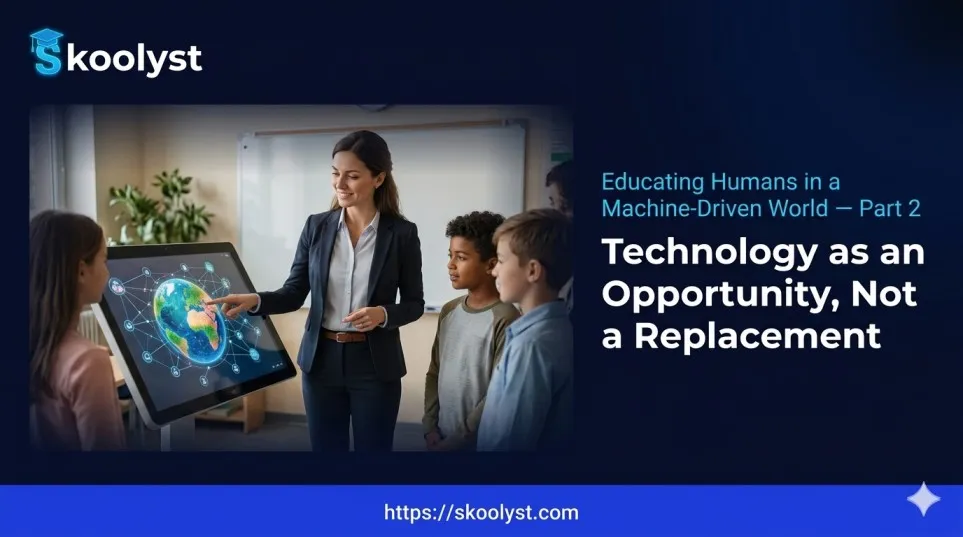
Technology does not replace good teachers. It amplifies them.
Technology Was Never Meant to Replace Humans
From the very beginning, machines were built to save time, reduce physical effort, improve accuracy, and connect people across distances. They were never designed to feel emotions, read the mood of a classroom, or guide a child's character through a difficult year.
A machine can deliver information. Only a teacher can deliver understanding.
Technology as a Learning Multiplier
When used wisely, technology opens doors that a textbook alone never could. It helps students visualize ideas that are hard to imagine, connects classrooms to the wider world, sparks curiosity, and supports learners who move at different speeds.
Think of a science teacher running a simulation of an experiment too dangerous or expensive to perform in class. Or a geography lesson that takes students on a virtual walk along a river they have only read about. Or a language class where students speak with peers from another country, hearing the rhythm of a new language for the first time.
But notice one thing in every example — the teacher is still in control. Technology supports learning. It does not lead it.
Guiding Students Through a Fast-Changing World
The world is shifting faster than at any point in history. New tools appear every year, and old skills quietly slip into the past. If students are taught only how to use tools, they will be lost the moment those tools change. If students are taught how to think, they will adapt to almost anything.
Teachers must help students ask the right questions, understand cause and effect, use technology responsibly, and apply what they learn to real problems in the world around them. This kind of guidance cannot come from a machine. It must come from a human who has lived a little, struggled a little, and learned what truly matters.
Technology as Opportunity, Not Just Employment
Technology should not be presented to students only as a path to a paycheck. "This is how you get a job" is a small idea. "This is how you improve the world" is a much bigger one.
Students can use technology to improve farming methods in their own communities, protect water resources, manage energy more wisely, connect people who feel isolated, and solve social problems that previous generations left unsolved. Technology becomes powerful when it serves human needs — not ego, not trends, not noise.
What This Means for Schools and Parents
Schools that use technology with purpose stand out almost immediately. Parents notice when teachers can explain why a tool is being used, when students learn balance rather than dependency, and when screens do not quietly replace values.
These are the schools that build trust in families and communities. Trust turns into confidence. Confidence turns into loyalty. And loyalty, over time, turns into growth.
Speed Without Direction
Technology gives us speed. But speed without direction only leads to confusion. If we teach students tools without teaching responsibility, we create users — not leaders.
The next challenge is bigger than any device or platform. It is about preparing students for uncertain futures, careers that do not yet exist, ethical decisions no generation has faced before, and the weight of human responsibility in an interconnected world.
In Part 3, we will look at how teachers can prepare students for that future — not just with skills, but with values, awareness, and real-world readiness. Because the future will not belong to those who know machines best. It will belong to those who understand humans, responsibility, and purpose.


Comments (0)
Join the Conversation
Please log in to leave a comment and share your thoughts.
No comments yet
Be the first to share your thoughts!